Get in touch!
We're here to help - feel free to reach out with any questions, thoughts, or requests, and we’ll get back to you as soon as we can.

For decades, traditional pharmacology dismissed oral gamma-aminobutyric acid (GABA) supplementation. The scientific reasoning appeared sound: as a polar hydrophilic molecule, exogenous GABA exhibits negligible permeability across an intact human blood-brain barrier. Consequently, online health forums frequently label GABA supplements ineffective, while some commercial brands incorrectly claim their formulations directly enter central brain tissue.
Recent mechanistic syntheses resolve this debate by introducing a paradigm shift. Emerging evidence demonstrates that oral GABA does not need to cross the blood-brain barrier to modulate central nervous system function. Instead, oral GABA acts peripherally within the gastrointestinal tract, communicating with the brain via enteric GABA receptors and the vagus nerve.
Pharmacokinetic investigations consistently confirm that oral exogenous GABA exhibits minimal passive transit across an intact human blood-brain barrier. Under standard physiological conditions, endothelial tight junctions and dedicated efflux transporters prevent significant accumulation of circulating GABA within the central nervous system or cerebrospinal fluid.
This biological barrier led researchers to assume that ingested GABA could not exert central physiological effects. However, this assumption overlooked the extensive neural architecture operating outside the skull, specifically the enteric nervous system surrounding the gastrointestinal tract.
For a broader examination of how GABA influences stress responses, physical performance, and cognitive health, explore our previous article on new GABA research in anxiety, fitness, and brain health.
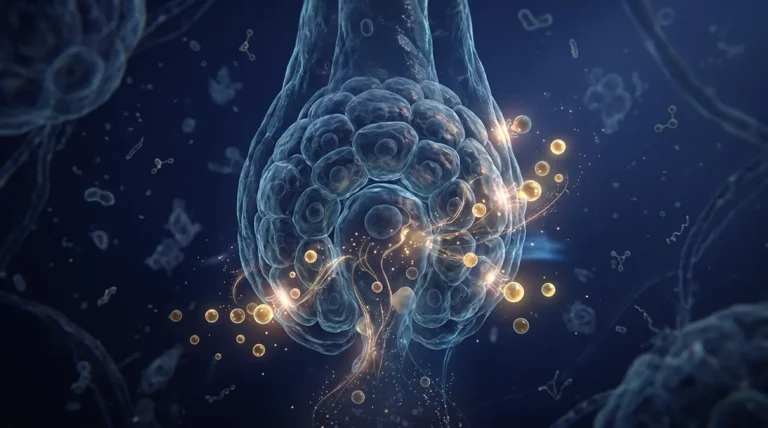
The gut is lined with hundreds of millions of neurons, earning it the designation of the second brain. Gastrointestinal tissue expresses high densities of both GABA-A and GABA-B subtype receptors. When oral GABA enters the digestive tract, it binds directly to these peripheral receptors embedded within the gut wall.
This peripheral binding triggers electrical impulses along vagal afferent nerve fibres. The vagus nerve, which serves as the primary neural superhighway between the gut and the brainstem, transmits these signals directly to central autonomic regulation hubs, including the nucleus tractus solitarius. From there, neural pathways project to central stress circuits within the hypothalamus and amygdala, modulating central nervous system tone without the GABA molecule itself ever entering the brain.
Although exogenous GABA remains largely outside the central nervous system, oral supplementation trials document measurable systemic changes in human physiology. Peripheral vagal stimulation downregulates sympathetic fight-or-flight activity while enhancing parasympathetic dominance.
Human clinical trials evaluating oral GABA administration demonstrate reproducible physiological shifts, including:
While physiological biomarkers such as HRV, EEG changes, and cortisol suppression are well documented in human clinical trials, mechanistic precision requires careful interpretation. Direct verification that vagal nerve transection abolishes these calming effects has been validated primarily in preclinical animal models rather than human subjects.
In human literature, markers remain indirect proof of peripheral mediation. Nevertheless, the convergence of gut-brain axis research, microbial GABA production analysis, and clinical biomarker tracking provides a compelling framework explaining how peripheral signalling influences central relaxation.
Understanding the gut-vagus paradigm allows consumers to approach oral GABA with evidence-aware expectations. Rather than acting as a direct central sedative, oral GABA functions as a peripheral autonomic modulator, quietening systemic stress pathways from the digestive tract upward.
For a wider overview of potential applications, including relaxation, sleep, and general wellbeing, read our comprehensive guide to GABA benefits.
Explore our targeted oral formulation: NOW GABA 750mg, designed to support autonomic balance and peripheral gut-brain signalling within an evidence-aware protocol.